Summary
The 3 5 7 rule is shorthand for the EPA’s AHERA bulk-sampling standard for friable surfacing material: collect 3 samples from a homogeneous area of 1,000 square feet or less, 5 samples when the area is more than 1,000 and up to 5,000 square feet, and 7 samples when it is more than 5,000 square feet. The key nuance is that this rule is not a universal sample count for every suspect asbestos material; thermal system insulation and miscellaneous or nonfriable materials follow different sampling approaches, and in New York City any renovation workflow still has to fit local survey, filing, and abatement requirements.
Asbestos sampling is having a real moment again because owners, contractors, and facility teams are all asking the same modern questions: How many samples are enough, what PPE is actually correct, and how do we stay compliant without stalling a project? In New York, that conversation is even sharper right now because official survey requirements, permit coordination, and respirator rules are all front-of-mind for renovation work.
The federal origin of the 3 5 7 rule
The 3 5 7 rule comes from 40 CFR 763.86(a) under AHERA, which governs asbestos inspections in schools. In plain English, the rule is built around the size of a homogeneous area of friable surfacing material, so the sample count rises as the suspect material area grows. That is why seasoned inspectors talk about the rule as a disciplined minimum, not a guess.
- 3 samples for a homogeneous area of 1,000 square feet or less
- 5 samples for a homogeneous area greater than 1,000 and up to 5,000 square feet
- 7 samples for a homogeneous area greater than 5,000 square feet
- The material must be sampled in a statistically random, representative way
- The rule is tied to friable surfacing material, not every suspect product in a building
Source note: these thresholds are stated directly in the EPA sampling rule.
Where the rule applies — and where it does not
This is where many blogs get sloppy: the 3 5 7 rule is often used as industry shorthand for “asbestos sampling,” but the official rule is narrower. Thermal system insulation generally requires at least 3 bulk samples with special exceptions, while friable miscellaneous and nonfriable suspected materials must be sampled in a manner sufficient to decide whether they are ACM; EPA has clarified that, at minimum, that means two samples for miscellaneous and nonfriable suspected materials because the regulation uses the plural word “samples.”
| Material category | Minimum sampling approach | Practical takeaway |
|---|---|---|
| Friable surfacing material | 3 / 5 / 7 samples based on homogeneous area size | This is the classic “3 5 7 rule” |
| Thermal system insulation | Usually at least 3 samples, with exceptions for patched sections and some fittings | Different rule, same need for trained judgment |
| Friable miscellaneous material | Sufficient samples; EPA says at least 2 | Do not force-fit 3 5 7 here |
| Nonfriable suspected material | Sufficient samples; EPA says at least 2 | Flooring, mastics, and similar materials need their own strategy |
Sampling note: the 3 5 7 thresholds come from 40 CFR 763.86(a), while EPA’s FAQ clarifies the minimum-two-sample interpretation for miscellaneous and nonfriable suspected materials.
- Do not assume one sample count fits every material
- Start by classifying the material type correctly
- Define the homogeneous area before counting samples
- Use accredited, certified inspection professionals
- Treat “rule of thumb” language as secondary to the regulation itself
Why NYC owners should care even though the rule started in schools
In New York City, the AHERA rule matters because it shapes how professionals think about defensible sampling, but local compliance is what turns theory into project reality. NYC DEP says building owners are responsible for having an asbestos survey performed by a DEP-certified asbestos investigator before work that may disturb ACM, and DOB requires asbestos assessment or certification steps before many renovation permits; meanwhile, Hi-Tech’s site positions the company around the exact services that close that compliance gap: inspection, testing, removal, and DOH-related support for residences, commercial buildings, and schools.
- Older NYC properties are especially likely to contain suspect ACM
- A survey is not just a safety move; it is a permit and schedule move
- DEP filings like ACP-5 and ACP-7 can become part of the workflow
- Penalties for skipping survey or filing steps can range from $1,200 to $10,000 per infraction
- A full-service contractor can reduce handoff delays between inspection, abatement, and compliance documentation
Source note: NYC DEP and DOB set the survey and filing framework; Hi-Tech’s website shows a service model built around executing it.
Body Section 2: PPE, project readiness, and the smarter NYC comparison
Is an N95 enough for asbestos work?
No — an N95 is not the right answer for asbestos work under OSHA. OSHA’s asbestos standard says employers must not select or use filtering facepiece respirators for protection against asbestos fibers, and it requires HEPA filters for powered and non-powered air-purifying respirators used for asbestos protection. That is one reason respirator selection is such a hot topic right now, especially with OSHA’s 2025 proposal to modernize some respirator provisions while still anchoring protection to the broader respiratory protection framework.
- Filtering facepiece respirators are not the asbestos standard solution
- HEPA filtration remains central in asbestos respiratory protection
- Higher-risk asbestos tasks may call for PAPRs or supplied-air respirators
- Respirator choice depends on exposure profile and work classification
- “Basic dust mask” thinking is exactly what owners and crews should avoid
What PPE is commonly expected around asbestos sampling and disturbance?
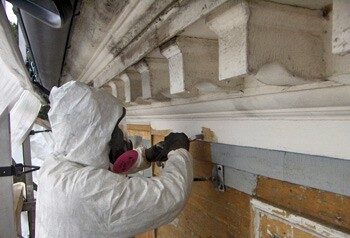
Yes, PPE still matters even before full abatement starts, because disturbing suspect material is the moment fibers can become airborne. NYC DEP notes that airborne asbestos can enter the respiratory system if appropriate PPE is not used, and OSHA requires protective clothing such as coveralls, gloves, head coverings, and foot coverings in specified asbestos-exposure conditions or where required negative exposure assessments are not available. For a small inspection, the exact ensemble should still be tied to the task, exposure potential, and the inspector’s protocol, but disciplined containment and PPE planning are non-negotiable.
- Respiratory protection should be chosen for asbestos, not generic dust
- Protective clothing may include coveralls, gloves, head coverings, and foot coverings
- Eye protection may be needed where irritation or splash concerns exist
- Sampling should be controlled to minimize fiber release and contamination
- Decontamination and handling procedures matter as much as the gear itself
Why a full-service firm compares well in this market
Hi-Tech’s website presents the company as a licensed, insured, end-to-end environmental abatement partner serving residential, commercial, and school settings across New York City and the five boroughs, with asbestos inspection, testing, removal, and broader environmental hazard support. Compared with a testing-only vendor, that model aligns neatly with what the internet and the regulations show owners actually need today: a survey, certified investigators, possible DEP/DOB paperwork, licensed abatement if ACM will be disturbed, and air-monitoring coordination before sign-off.
- One team can help connect sampling, reporting, and remediation
- It is easier to protect schedule when compliance planning starts early
- Licensed abatement support matters if the survey confirms ACM
- NYC paperwork and clearance steps can be easier with an experienced local operator
- Owners gain a cleaner path from discovery to documentation to project restart
Ready to book asbestos testing in NYC?
If your renovation, demolition, or compliance project needs clarity fast, the smartest next step is to book an asbestos survey and compliance consultation with a team that already works in the NYC regulatory environment. You can also call (718) 450-4138 or email info@hitechnyc.com to schedule a quote and map out the right survey, filing, and abatement path before work begins.
FAQ
- What is a homogeneous area in asbestos sampling?
A homogeneous area is a section of material that is uniform enough in type, color, and texture to be sampled as one group; the 3 5 7 rule depends on defining that area correctly first. - Does the 3 5 7 rule apply to floor tile and mastic?
Not automatically. Friable surfacing material uses the 3 5 7 thresholds, while miscellaneous and nonfriable suspected materials are sampled in a sufficient manner; EPA says at least two samples are needed for miscellaneous and nonfriable suspected materials. - What is the difference between ACP-5 and ACP-7 in NYC?
DOB explains that ACP-5 is used where the work does not constitute an Asbestos Project as defined by DEP, while ACP-7 is the Asbestos Project Notification used when the scope of work does constitute an asbestos project. - Do post-1987 buildings skip all asbestos requirements in NYC?
No. DOB says buildings constructed after April 1, 1987 may qualify for asbestos certification exemptions in some alteration contexts, but any known ACM that will be disturbed must still be abated under DEP rules. - Can a homeowner use a DIY asbestos test kit for a regulated project?
For a regulated New York project, the safer and more defensible route is a certified inspector and approved lab workflow. NYC DEP says owners are responsible for having a survey performed by a DEP-certified investigator, and NYS DOL says renovation, demolition, remodel, or repair work requires a survey by a certified New York State Asbestos Inspector or the building must be assumed to contain asbestos.